
Costs
We are dedicated to uplifting single mothers in rural Kenya by providing food and a lasting source of income, such as animals or seed and water for farming. We also provide health services and build decent latrines. The cost of supporting one woman and her children for one year and giving her a (hopefully permanent) means of income is USD 2500. Smaller amounts are very welcome. Every time we reach USD 2500 we add one deserving family to the programme.
The Project


Donations
There are no overhead costs because work on the project is done by volunteers, and base costs are covered by the project group. We don’t give bribes. We don’t support women who either drink excessively or cook alcohol, as alcohol abuse is a huge problem in the community. We use local labour when at all possible. We emphasise that we are giving the help freely and that the beneficiaries owe us nothing. The only thing we require is reasonable behaviour vis-à-vis alcohol. We do request, however, that they think about helping others, so as to pay forward what they receive.
We support mostly women, as women generally can be counted on to be significantly more responsible that men, and single mothers have significantly less opportunities to make money than men.
We are affiliated with (and endlessly helped by) the Belgian registered charity Caprioolkinderen which runs the INUKA Pamoja initiative in Kenya. Contributions are to be sent to Caprioolkinderen’s account in Belgium.
Huge thanks to:
Eddy de Nil
Bernadette Mecha
Anne Okech-Kristensen
FOR MORE INFORMATION OR TO SUPPORT THE WOMEN, SEND MARTIN EHRENSVÄRD AN EMAIL AT MEHRENSVARD@GMAIL.COM

History
The project is run by Martin Ehrensvärd (whose day job is Associate Professor at the University of Copenhagen) who founded it in July 2025, seeing a fantastic opportunity to change lives from despair to hope.

Updates July 2026
It is wonderful to see how well most of the single mothers are taking advantage of our support. They work hard on their land and with their livestock or in their shops, and they earn well and are able to create much better lives for themselves and their children. As the project has developed and we see these effects, we have expanded the scope of support. See myriad examples below.
Small businesses

Sharon, the local tailor, has lots of work with making school uniforms for the children we support. The children are supremely happy to have new, good-looking uniforms.

Here’s the menu in the restaurant that we’ve started. We keep the prices very low so that locals can afford it. Prices are in Kenyan shillings. 10 shillings for a chapati or a cup of tasty milk tea equals 8 cents in the US. Thus, a healthy portion of delicious githeri will set you back a quarter.

Here is Winnie who runs the hoteli (i.e. restaurant/café). She feeds workers and she works very hard. She makes good money because we give her all supplies for free, pay her rent etc.

We have built and stocked a salon for women and one for men so as to give an income to some of our beneficiaries.

The male hairdresser (a disabled man) doubles as a shoemaker

We have built and stocked several shops for single mothers wanting to try their hands at shopkeeping. Maggie’s shop here ran well from the get-go – she read the market well.
Schooling

We support children like this with school fees and uniforms

These are parents of the children we support. We require from them that they provide food for their children for school. In this way, we share the responsibility. If they keep up their end, we promise to support their children through 9th grade at least.
Clinic

This baraza (community gathering) gives overwhelming support for building our clinic on community land. It’s a long walk to the nearest clinic right now, and those neighbouring clinics are busy. The intention is to offer high-quality, free health services to the community.

The clinic is taking shape.

Here is the blueprint. There will be four rooms.

There will be a female and a male water closet. This large septic tank will be built with a so-called root bed for environmental protection.

The team of local guys laying the clinic ground work
Health, health insurance, and H. pylori

This is the kind of toilet and bath house we build for the single mothers that we support.

Their toilets typically looked like this before – a hole in the ground with planks, and for privacy, sometimes polyethylene wrapped around four sticks.

Occasionally beneficiaries will have very poor teeth. We pay for the dentist. This kind of teeth are dangerous because they can lead to bad infections.
We pay health insurance (SHA) for all beneficiaries. We pay for transport to the nearest hospital when needed, for them and their children. Many children suffer from ulcers caused by H. pylori. The treatment is relatively costly, so parents can’t afford it. We pay for that for all needy children in the area.
Food support

Everlyne here is single and disabled and has four kids, of which one boy is disabled. They get food supplies from us every month, in addition to the other benefits (livestock, health, schooling etc.).

Here are the single mothers that receive support of various kinds, including food, means of income, schooling, health, sanitation, water for farming.

Four out of five members of Hellen’s family are disabled, so we support them, even though she is not a single mother. Time limit of our support for a family is normally one year (after which they are supposed to support themselves, although we’ll keep supporting the kids in school and to pay for health insurance), but Hellen and family (and other disabled and elderly and vulnerable persons) will continue to receive support.

Guys like this we also support, since he has no family to take care of him

Winny, one of the beneficiaries. Like the others, her husband vanished and does not help her, or see the kids. That makes for a very hard life in rural Kenya. Winny now has a proper toilet, several healthy sheep and a shelter, water for her small plot, health insurance, and school support for her children – like the other beneficiaries.

Martin regularly walks around the area, visiting the beneficiaries.

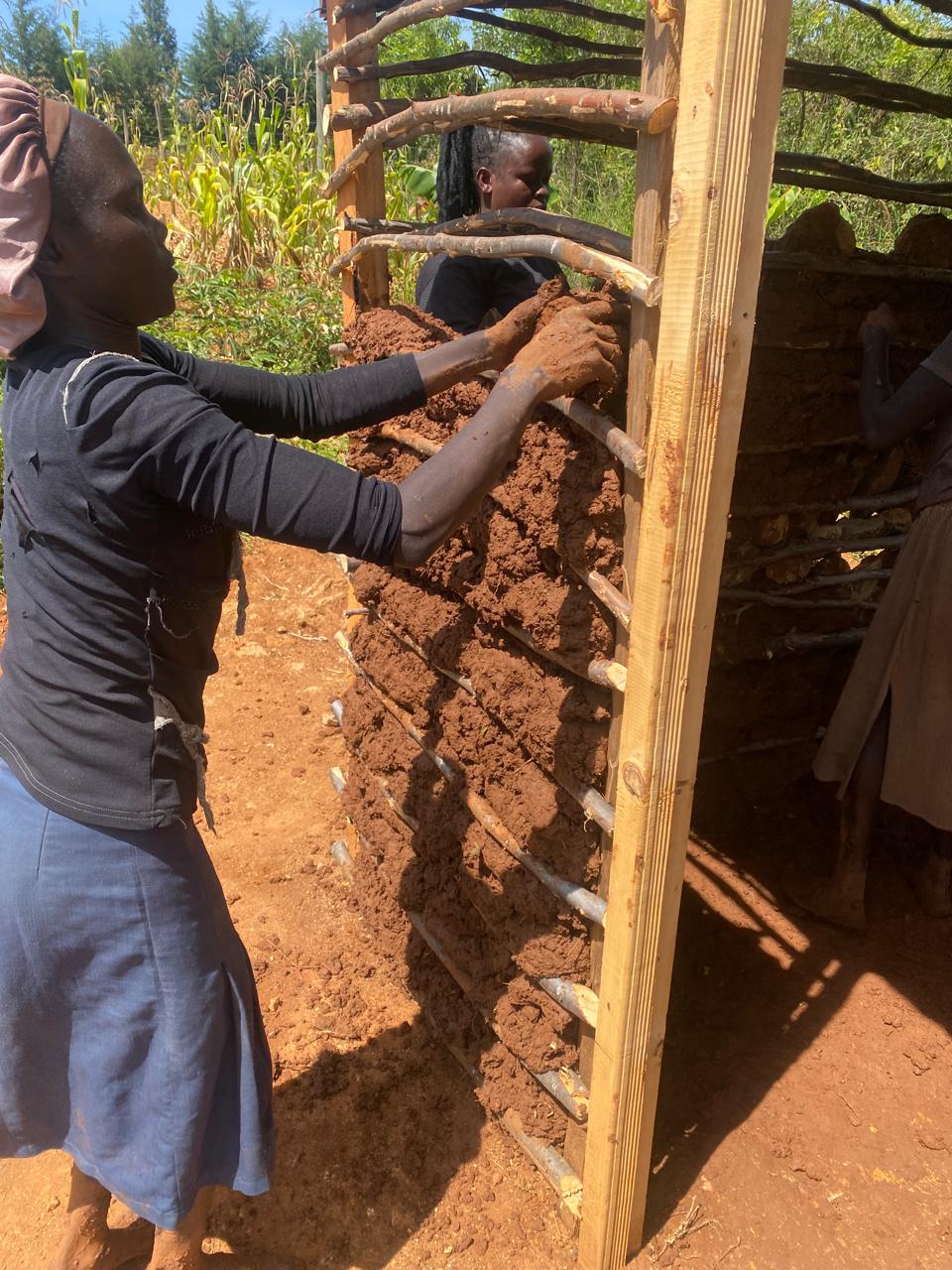
The local women help build a new house to a gogo, grandmother, with disabled children who are unable to help her. She used to live in a lice-infested house which was falling down. We built her a new house and destroyed her mattress and clothes. We gave her a new clean bed and wardrobe. She’s diabetic, so the nurse looks after her, and we try to convince her to eat the suitable food we give her. We have hired a single mother to cook and clean for her.

Here’s a house we built for a single mother, Gladys, with five children between the ages of 8-17.
Livestock


Judy’s sheep and lamb in her shelter

This is the type of shelter we build for beneficiaries. Animals are visited by the vet every month and are given ample food, making for strong and healthy animals.
Farming and water supply

Many of the single mothers lacked a water source for their small plots. We have supplied that for all of them (sometimes having to draw pipes from 1 km away), adding tanks like the above when necessary.

Sources like this one

Water now coming in like this

Gladys’ maize looked like this on 26. April 2026

One month later, it had grown.

Another 12 days (this is 8. June, 2026) and the maize was very tall and green, while Gladys was so proud and happy that it makes the heart sing.


This is Nancy’s farm. These are seed beds for onions. They will soon be moved to other soil.
Football and other ambitions
We’ve started to support football and volleyball. The single mothers have formed teams, and in the future we will support girls football and netball too.
Other ambitions (apart from expanding the project to help more and more needy families in the region) include setting up a Nyawa Girls Club with various types of support, health information, sports, and mentoring for girls aged 12-17. Another ambition is street lights, making business in the evening more viable. A public bathroom is another thing we hope to achieve.

Housing

We sometimes build houses with mabati, i.e. metal sheets. But we prefer building houses for beneficiaries like this, relatively traditional mud houses, except that we use metal sheets for roofs.
The team

The team is out visiting beneficiaries

Team meeting at Peter’s house. Peter does a tremendous amount of volunteer work for the project.